

Evan Gershkovich Recounts the Moment He Realized Russia Had Set a Trap: 'They Fabricated This Case'
Wall Street Journal correspondent Evan Gershkovich has offered a detailed account of the moment he understood that Russian authorities had deliberately ensnared him, describing how
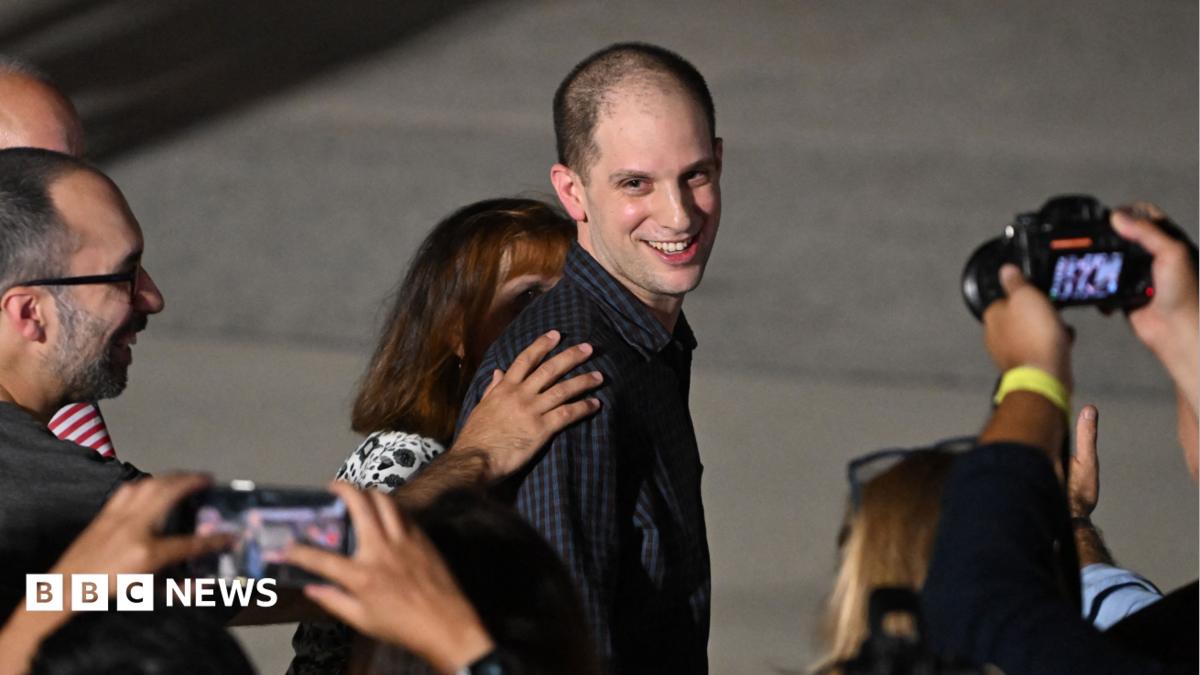
Wall Street Journal correspondent Evan Gershkovich has offered a detailed account of the moment he understood that Russian authorities had deliberately ensnared him, describing how masked security agents surrounded him at a restaurant in Yekaterinburg in 2023 and placed him under arrest on fabricated espionage charges. Speaking to BBC Radio 4's Today programme, the 34-year-old American journalist said he recognized almost immediately that the case against him was manufactured — not because he had done anything wrong, but because Moscow wanted a valuable bargaining chip.
Gershkovich had been living in Russia since 2017 and was working as the Journal's Moscow correspondent when he traveled roughly 1,600 kilometers east of the capital to meet a person he believed was a source for a story. The two men were seated in a half-empty dining hall when, according to Gershkovich, around half a dozen masked men entered and told him, "I think we booked that table." He described the phrase as strange at first but later recognized it as a calculated tactic designed to freeze a target in place before an arrest could be carried out.
The men identified themselves as officers of the FSB, Russia's powerful domestic security service. At that instant, Gershkovich said, the gravity of the situation became unmistakable. When the FSB is involved, he explained, it is clear that an operation has been planned in advance rather than improvised. The man he had come to meet vanished into the crowd, leaving Gershkovich to face the consequences of what he now firmly believes was a setup from the start.
What followed was a realization that would shape his entire experience of captivity. Gershkovich noted that he was neither interrogated nor tortured — tactics Russian security services routinely deploy against people accused of spying. Instead, that absence of brutality carried its own meaning. He described an odd sensation of relief washing over him when he concluded that the authorities were not treating him as a genuine intelligence agent, but rather as a commodity: a hostage whose value lay in what Moscow might extract in exchange for his freedom.
"They've set me up and fabricated this case so that I can be a valuable hostage, a pawn in a greater game," he recalled thinking. That understanding, painful as it was, gave him a strange form of clarity. He reasoned that his detention would likely last a long time, but not the 12 to 20 years that a real espionage conviction might carry. That conclusion, he said, helped him remain stable and disciplined throughout his imprisonment.
Gershkovich was ultimately sentenced to 16 years in a Russian penal colony, a punishment his employer and he have always insisted was based on false charges. He spent 16 months behind bars before being released on August 1, 2024, as part of a high-profile multinational prisoner swap. Now based in Berlin, he continues to speak publicly about his ordeal and the broader implications of how Russia uses detained foreigners as leverage.
His prediction that his case would become an international cause proved correct. Media organizations around the world covered his arrest extensively, his face appeared on a billboard in Times Square, and then-US President Joe Biden stated publicly that he had "no higher priority" than securing Gershkovich's return. From Gershkovich's perspective, that global attention was not an unintended consequence of Russian actions but part of the plan all along: Moscow wanted a high-profile prisoner it could eventually trade for one of its own operatives.
That operative turned out to be Vadim Krasikov, an assassin serving a life sentence in Germany. Gershkovich argued that Moscow effectively achieved its objective without facing meaningful consequences. No sanctions were imposed in connection with the case, he noted, adding that from a cynical vantage point, the Kremlin played its hand shrewdly. His assessment underscores a wider concern among analysts about the risks journalists and other foreign nationals face in Russia, where detentions can become instruments of statecraft rather than matters of justice.
During his imprisonment, Gershkovich was held in Moscow's Lefortovo jail, a facility with a grim history. Over the decades it has housed high-profile political prisoners and dissidents, and during Joseph Stalin's Great Terror in the 1930s, torture and execution were commonplace within its walls. Gershkovich described the experience as deeply isolating, confined to a tiny space in a way that wears on a person psychologically over time. Even so, he acknowledged that he was treated relatively well: he was allowed to sleep, and the food was adequate.
His public appearances during court hearings became a form of quiet resistance. Images of Gershkovich smiling at cameras in Moscow were broadcast around the world, and he said that was deliberate. He wanted to project defiance and signal to observers that he was holding up, refusing to let what he described as a theatrical legal process unfold entirely on Moscow's terms. If the proceedings were a performance, he reasoned, he would not allow the script to run exactly as the Kremlin intended.
At the same time, Gershkovich has been careful to distinguish his treatment from that of other detainees. He stressed that many people held in Russian prisons endure torture, are psychologically broken, are deprived of food and hot water, and are told they will never see their families again. He pointed to the case of Ukrainian journalist Viktoriia Roshchyna, who died in Russian captivity in 2024 at the age of 27. When her body was eventually returned months later, reports indicated signs of torture and that her organs had been removed. The contrast, he suggested, highlights how selectively Moscow calibrates its treatment of prisoners depending on their perceived value.
Gershkovich learned about the planned prisoner swap three weeks before it occurred, a period he described as excruciating because each day dragged on painfully. When the exchange finally took place, he experienced what he called pure joy. Yet that euphoria was short-lived. The adrenaline faded, and he was confronted with the difficult reality of rebuilding a normal life. He admitted that the transition was sometimes overwhelming.
His account offers a rare window into the mechanics of state-sponsored detention and the emotional aftermath of being used as a geopolitical pawn. It also raises uncomfortable questions about the protections available to foreign journalists operating in Russia and about whether the international response — however loud — ultimately deterred future abuses or simply became part of the calculation. For Gershkovich, the answer appears to be the latter, a sobering conclusion from someone who lived through the trap firsthand.
What's Your Reaction?
 Like
0
 Dislike
0
 Love
0
 Funny
0
 Wow
0
 Sad
0
 Angry
0

Reporter Senior. Meliput dinamika politik nasional, kebijakan publik, dan isu parlemen selama 8 tahun. Alumni FISIP UI.






Comments (0)