 rizky-amelia
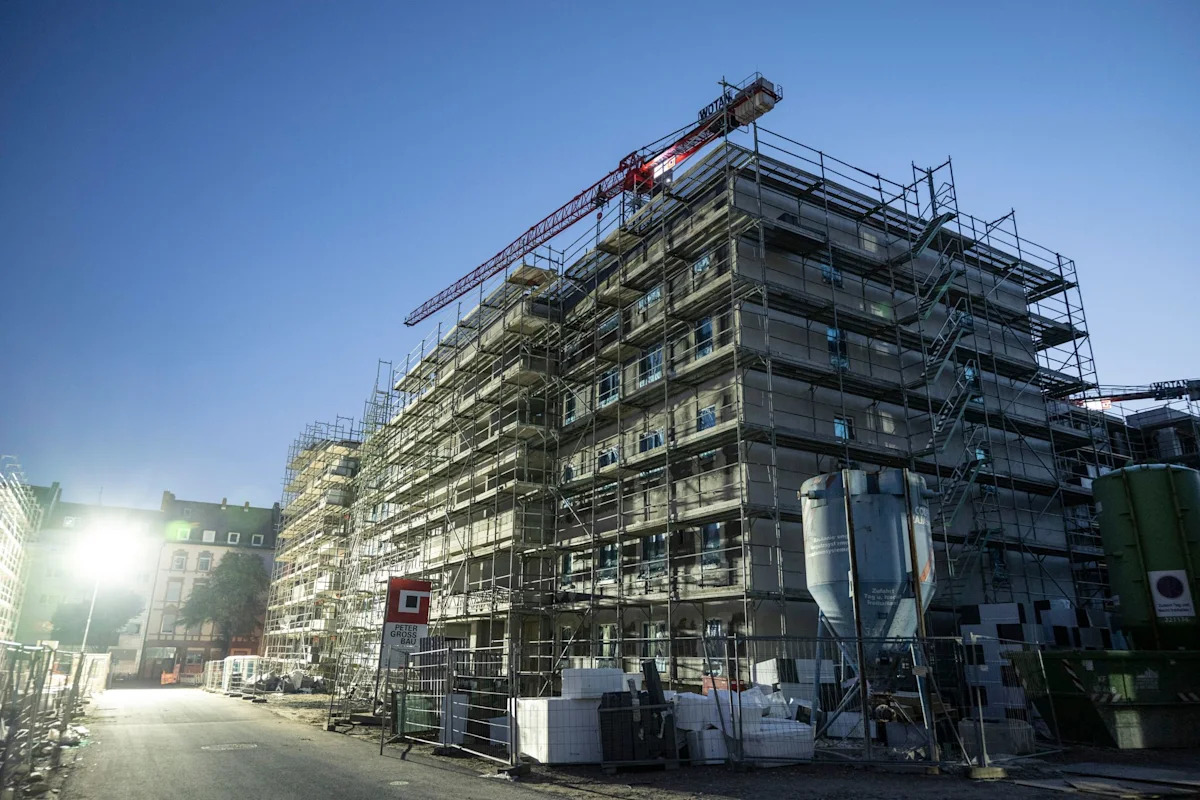
Germany's deep downturn in residential construction has taken a measurable toll on the wider economy, stripping an estimated 0.6 percentage points from gross domestic product, according to research published on Wednesday. The Construction Monitor 2026, compiled by the Pestel Institute for the Federal Association of German Building Materials Retailers, calculates that around 84,600 fewer homes were completed in 2025 than in 2023.
The study measures the damage against a baseline of "stable construction activity," assuming the country would have kept building roughly 300,000 homes a year as it did previously. Official figures from the Federal Statistical Office show just 206,600 dwellings were actually finished last year. Against that benchmark, the institute estimates the building trade lost about €26.9 billion ($31.4 billion) in revenue across the two years, while federal and regional tax receipts came in roughly €7 billion short.
"Economic growth only works with more housing construction," said Matthias Günther, who heads the Pestel Institute. His team's analysis points to a national housing deficit of 1.35 million homes — a figure it had previously calculated at the start of this year for the Social Living Alliance.
The shortage is also acting as a drag on the labour market, the researchers warn. In regions with strong economies, employers struggle to fill open positions when workers cannot secure affordable places to live nearby. The gap is especially stark in major population centres: Berlin alone lacks at least 58,000 homes and Hamburg 23,000, while North Rhine-Westphalia is short 364,000 units, Bavaria 220,000 and Baden-Württemberg 201,000. People simply will not relocate for a job if there is nowhere affordable to live, Günther noted, adding that this mobility barrier depresses growth and overall prosperity.
There are tentative signs of a turnaround on the supply side. Permit applications rose 15.1% in the first half of the year to 126,300 units, according to the Federal Statistical Office. Yet industry representatives remain downbeat about actual output.
"The collapse in residential construction is catastrophic," said Katharina Metzger, president of the building materials retailers' association, whose group expects completions to fall further to just 185,000 new-build homes in 2026. She argued that now would be precisely the wrong moment for the federal government to trim housing subsidies by €1.4 billion — a move that would leave only €2 billion in support available in 2027 — insisting instead on dependable, sustained funding.
Metzger also urged swift adoption of the proposed Type E simplified construction standard, which would allow developers to erect apartment blocks of up to 12 units without obtaining separate planning approval, provided their schemes conform to the applicable development plan.










Comments (0)