

Canadian Prime Minister Carney Backs Groundbreaking EU Associate Membership Proposal Amid Transatlantic Friction
Canadian Prime Minister Mark Carney has formally embraced an ambitious initiative by the European Union to establish Canada as the bloc's inaugural associate member. Delivering an
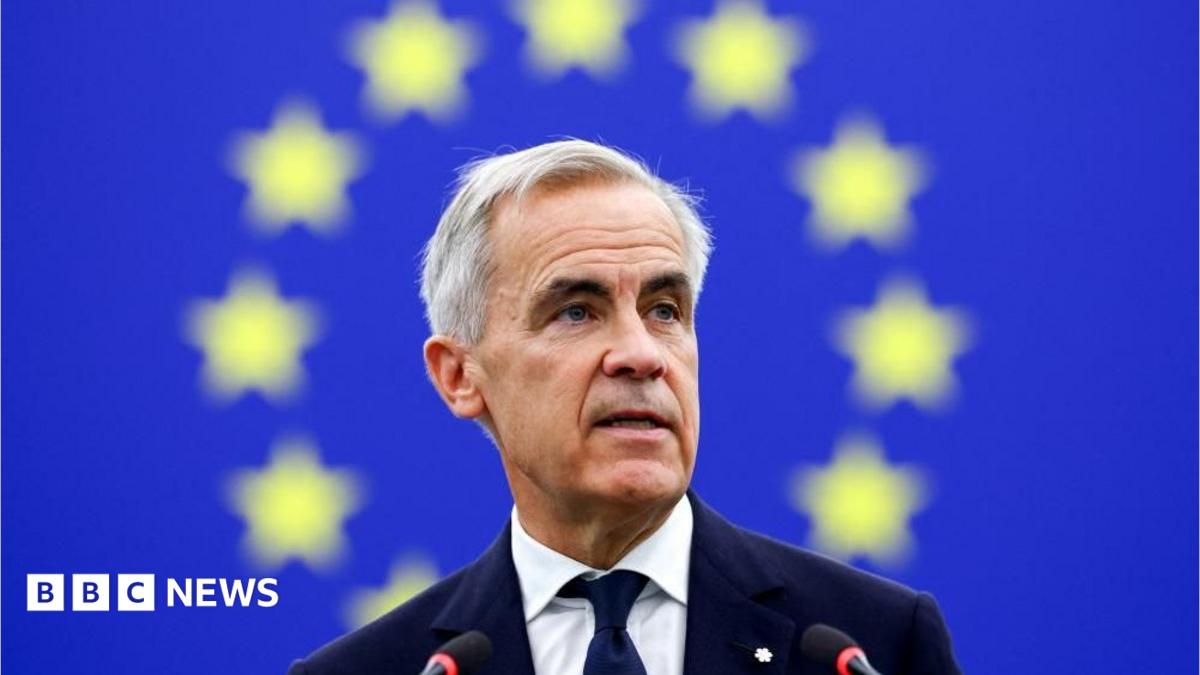
Canadian Prime Minister Mark Carney has formally embraced an ambitious initiative by the European Union to establish Canada as the bloc's inaugural associate member. Delivering an address to the European Parliament in Strasbourg, the Canadian leader advocated for a significantly closer partnership across vital strategic sectors, asserting that Ottawa and European capitals are vastly more resilient when operating in unison amid growing global instability.
Addressing European lawmakers, Carney outlined a vision centered on strengthening shared resilience in defence, securing critical mineral supply chains, and reinforcing energy security. He stated that democratic partners must stand together against ongoing geopolitical ruptures, emphasizing that collaborative action across the Atlantic offers a stabilizing force in an increasingly unpredictable international landscape.
The prime minister's remarks followed an initiative presented by European Commission President Ursula von der Leyen, who proposed opening pathways for Canada to attain associate status within the union. Von der Leyen’s vision encompasses expanded cooperation in manufacturing, technology, economic security, defence, and critical natural resources, offering Canada an unprecedented relationship with the 27-nation bloc.
The transatlantic proposal swiftly drew sharp criticism from US President Donald Trump, who dismissed the associate membership concept as laughable. The American leader warned that Washington could impose severe tariffs or dramatically curtail trade ties with Europe if the United States perceives the burgeoning pact between Ottawa and Brussels as a hostile act against American interests.
These warnings come against the backdrop of strained relations between Washington and Ottawa, with Canada and the United States currently embroiled in an intensifying trade conflict. The economic friction between the two North American neighbors worsened significantly after high-level bilateral trade negotiations collapsed last month, leading both sides to implement retaliatory tariffs against one another.
In his Strasbourg address, Carney pointed to multiple converging crises buffeting modern societies, citing climate change, the weakening of democratic norms, and the overt weaponisation of global commerce. He warned that traditional economic integration has increasingly been transformed into an instrument of geopolitical pressure, with tariffs and financial mechanisms deployed for coercion while vulnerable international supply chains are exploited.
To counter these systemic vulnerabilities, Carney argued that a fortified Canada-EU relationship could serve as a beacon for other democratic nations around the globe. However, he was careful to clarify that this partnership is not designed to create a confrontational third power bloc, maintaining that neither side seeks great-power rivalry or dominance over other states, but rather the preservation of self-determination and sovereign choice.
Addressing the American president's warnings during a subsequent press briefing, Carney characterized the proposed alliance with Europe as an inherently constructive and positive undertaking. He underscored that the Canadian public stands resolute in safeguarding its autonomy, remarking that outside powers will not dictate Canada’s cultural identity, national languages, or sovereign decisions regarding international partnerships.
The prime minister also took care to manage expectations regarding institutional integration, explicitly clarifying that Canada is neither seeking nor positioned to pursue full membership within the European Union. Instead, he described the associate arrangement as an entirely distinct framework tailored to meet contemporary economic and security imperatives without attempting standard accession.
Despite the high-level enthusiasm, the creation of an associate membership category presents significant diplomatic and legal challenges. Because such a formal tier does not currently exist within the EU’s institutional architecture, designing and enacting the necessary framework could require several years of delicate negotiation and unanimous approval from all 27 member states, some of which have previously voiced skepticism about establishing alternative membership tiers.
Nevertheless, proponents note that the initiative would build upon an already substantial foundation of cooperation. Ottawa and Brussels currently operate under an established comprehensive free-trade agreement, maintaining active collaboration across diverse fields such as technological innovation, security, defence coordination, and scientific research.
Outlining tangible avenues for collaboration, Carney emphasized that joint efforts could substantially bolster mutual strategic autonomy. Under the envisioned framework, Canada could provide essential supplies of liquefied natural gas and hydrogen to ensure European energy stability, while simultaneously gaining from European leadership in clean-energy technology and establishing robust partnerships around critical minerals.
Beyond trade and industrial collaboration, the proposal envisions deeper societal connections through youth mobility. Carney suggested integrating Canada into the European Union's Erasmus+ program, a move that would enable young Canadians and Europeans to study, work, and reside across the Atlantic with greater ease, fostering stronger cultural and educational exchanges.
The Canadian leader concluded by noting that both sides are merely at the start of a prolonged journey that will require extensive domestic deliberation, including a formal debate and vote within the Canadian parliament. Concrete discussions regarding the mechanics of the associate status are scheduled to take place when Canadian and European officials convene for a bilateral summit in Montreal at the end of October.
What's Your Reaction?
 Like
0
 Dislike
0
 Love
0
 Funny
0
 Wow
0
 Sad
0
 Angry
0

Reporter Senior. Meliput dinamika politik nasional, kebijakan publik, dan isu parlemen selama 8 tahun. Alumni FISIP UI.




Comments (0)