

Russian Glide Bomb Attack on Civilian Buses in Kramatorsk Kills at Least 30 as Ukraine Faces Escalating Strikes
At least 30 people lost their lives when Russian glide bombs struck two civilian buses in Kramatorsk, a front-line city in eastern Ukraine, according to rescue officials. The attac

At least 30 people lost their lives when Russian glide bombs struck two civilian buses in Kramatorsk, a front-line city in eastern Ukraine, according to rescue officials. The attack, which occurred on Thursday, also left 18 others wounded, said Vadym Filashkin, the head of the Donetsk regional administration. Authorities reported that three additional people were killed in the village of Bilenke, which falls within the Kramatorsk community, bringing the total death toll from the day's attacks in the area to at least 33.
Filashkin accused Russia of deliberately targeting buses full of passengers in order to inflict the maximum possible number of civilian casualties. The strike represents one of the deadliest single incidents in recent weeks, underscoring a dramatic surge in Russian attacks across Ukraine that has resulted in a heavy increase in civilian deaths. According to United Nations figures, more civilians were killed in Ukraine by August of this year than in the entirety of 2025.
Images released by local prosecutors showed the charred metal shell of a bus, with flames still visible inside and black smoke billowing out, alongside debris and the bodies of victims scattered on the road. The Kramatorsk city council described the attack as a "horrific crime committed by the Russian army against the civilian population," stating that "once again, the Russians have struck a location where there are absolutely no military targets."
Ukrainian President Volodymyr Zelensky vowed that the strike would not go unanswered. In a post on Telegram, he said, "Russia is trying to destroy all life in Donbas, and the world needs to react to this. React harshly – exactly as the Russians deserve for all the deaths they have caused." He also offered his condolences to the families and loved ones of those affected and called on Ukraine's international partners to provide "concrete action through new defence packages for the protection of Ukraine."
The attack on Kramatorsk is part of a broader escalation in Russian aerial campaigns targeting both military and civilian infrastructure. Kramatorsk and the neighbouring city of Slovyansk form part of what is known as a "fortress belt" that Moscow is attempting to seize as part of Russian President Vladimir Putin's stated goal of claiming the entire Donbas industrial region. Donbas comprises the Luhansk and Donetsk regions. With most of Luhansk already under Russian control, the Kremlin is now focused on capturing the remaining 20% of Donetsk territory still held by Ukrainian forces.
For much of the war, Kramatorsk served as a critical logistics and supply hub for the Ukrainian military. However, it has now come under almost daily Russian attack as Moscow's forces advance closer to the city's eastern outskirts. Glide bombs, which are fitted with winglets that allow them to glide toward their targets rather than simply falling, have been used extensively against both Slovyansk and Kramatorsk. In late August, as many as nine glide bombs were fired at Kramatorsk in a single day, signalling a sustained and intensifying campaign.
Following the deadly attack, Filashkin appealed to anyone still remaining in the eastern front-line region to evacuate to safer parts of Ukraine. He noted that given the sharp deterioration of security in the two neighbouring cities, all public transport had been ordered to stop. "The safety of civilians was paramount," he said, adding that "we have no right to risk the lives of passengers and drivers."
Moscow has yet to comment on the Kramatorsk strike. The Kremlin has frequently cited the "liberation" and "protection" of the predominantly Russian-speaking Donbas as justification for the full-scale invasion launched in 2022 – a claim that Ukraine and its Western allies have consistently rejected as baseless.
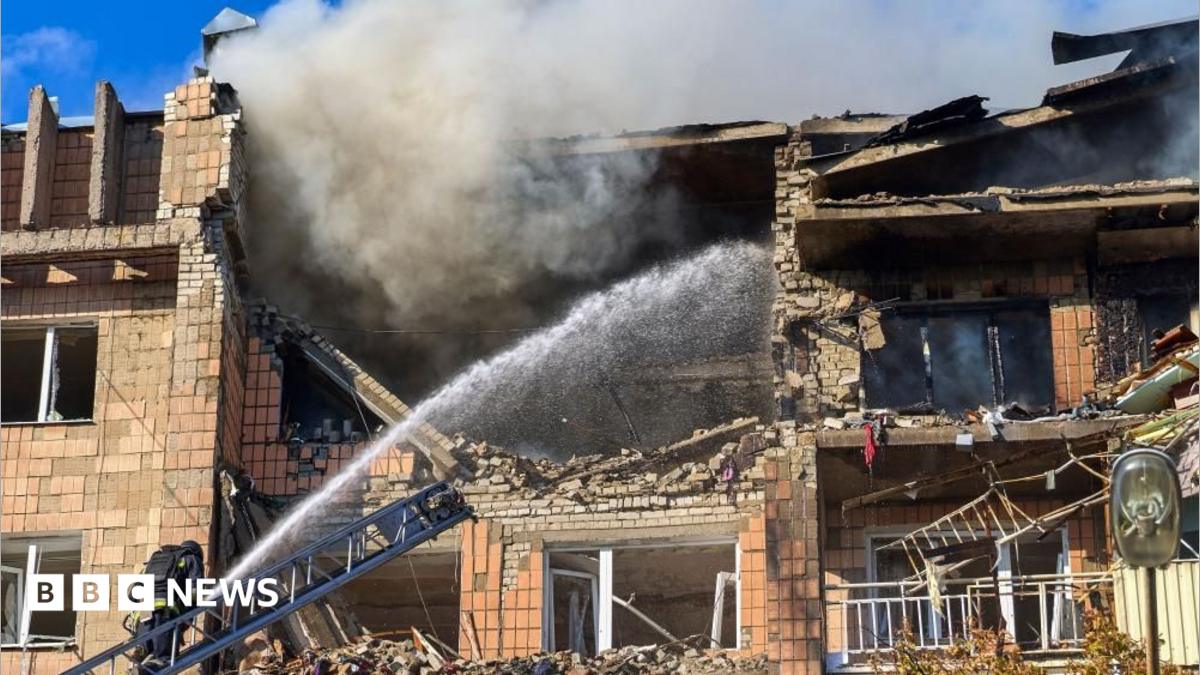
The attack comes amid a wave of deadly strikes across Ukraine. In one single attack early on Wednesday, a five-storey apartment block in Pryluky, east of Kyiv, was destroyed, killing 22 people, including five children. Three of the children were only one year old. UK Foreign Secretary Ed Miliband, who visited the site of the Pryluky strike alongside Zelensky, said the attack demonstrated Putin's "evil intent and evil strategy." He announced "more sanctions on Russia, on the war machine of Putin, on the shadow fleet, on the oil companies, on the crypto, on the financing of the war," and assured Zelensky that the UK would stand with Ukraine "as long as it takes for you to prevail in this conflict."
In recent weeks, Russia has launched constant air raids on Kyiv, with air raid sirens ringing virtually non-stop. On Thursday, Kyiv police reported that four people were killed and two injured in the latest Russian attack on the capital. The sustained bombardment is forcing schoolchildren out of classrooms and into underground shelters, shuttering businesses, and disrupting public transport across the city.
Moscow's strikes on Ukraine's key infrastructure, particularly the energy grid, are already causing power outages and even affecting the water supply. Local water authorities in Kyiv warned on Thursday that pressure was dropping across the city's right bank due to power cuts. The capital's metro network, which millions of residents rely on, briefly halted all train traffic on Thursday due to a voltage drop from "external power centres." Trains later resumed service but at greater intervals, according to local officials.
The escalating civilian toll has prompted renewed calls from Ukrainian officials for stronger international action. Zelensky and other Ukrainian leaders argue that additional air defence systems and new sanctions are urgently needed to protect civilians and degrade Russia's capacity to wage war. The Kramatorsk bus attack, with its explicit targeting of civilian transport, is likely to intensify those appeals. As rescue workers continue to recover bodies from the wreckage, the incident stands as a stark reminder of the war's growing cost for ordinary Ukrainians living near the front lines.
What's Your Reaction?
 Like
0
 Dislike
0
 Love
0
 Funny
0
 Wow
0
 Sad
0
 Angry
0

Reporter Senior. Meliput dinamika politik nasional, kebijakan publik, dan isu parlemen selama 8 tahun. Alumni FISIP UI.


Comments (0)