

Newly Disclosed Photographs Reveal Severe Toll of Iranian Strikes on US Middle East Bases
Newly revealed photographs obtained from active-duty military personnel depict widespread devastation across several American military installations in the Middle East, offering a
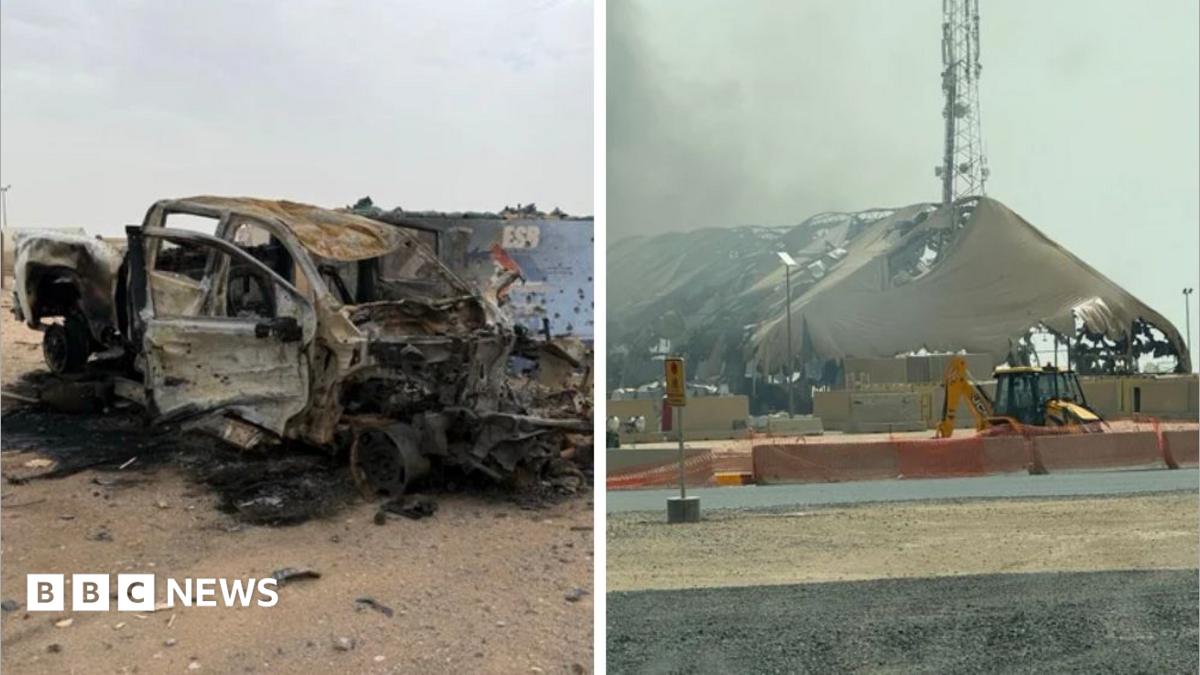
Newly revealed photographs obtained from active-duty military personnel depict widespread devastation across several American military installations in the Middle East, offering a stark visual record of the toll inflicted by Iranian retaliatory strikes. The images, originally secured by CBS News, capture a landscape of shattered infrastructure, ranging from torn-apart surveillance aircraft to flattened living quarters and charred military facilities.
The visual evidence highlights significant destruction at heavily fortified American installations in Saudi Arabia and Kuwait. Among the scenes documented are crushed trailers, ruined civilian and military vehicles, and substantial multi-storey compounds bearing direct structural impacts. The emergence of these photographs provides concrete imagery to support recent oversight assessments detailing the physical consequences of the ongoing conflict.
The release of the images has also highlighted growing frustration among service members deployed in the region. One anonymous military source quoted by CBS expressed acute dissatisfaction over how the conflict’s realities are being shared, stating that severe destruction inflicted upon American installations has not been adequately conveyed to the public. The service member described the vulnerability of stationed forces, comparing the situation to standing with closed eyes while taking blows to the face.
In response to inquiries regarding the photographs and the extent of base destruction, the White House directed reporters to US Central Command. Officials at Centcom did not provide an immediate response to requests for comment. While the photographs have not undergone independent verification by the BBC, their contents align closely with previously verified reporting and official accounts of missile impacts across the theatre.
The publication of these images comes immediately after the release of an official report by the Pentagon's inspector general. That watchdog investigation confirmed that Iranian strikes have damaged or completely levelled hundreds of individual structures and buildings situated across American bases in eight regional nations: Saudi Arabia, Kuwait, Bahrain, Qatar, the United Arab Emirates, Iraq, Oman, and Jordan.
Among the most severe losses shown in the newly surfaced material is the destruction of a Boeing E-3 Sentry aircraft at Prince Sultan Air Base in Saudi Arabia, situated roughly 62 miles southeast of Riyadh. The photograph shows the massive aircraft severed completely in half, with its tail assembly reduced to a mangled heap of metal on the airfield tarmac.
The Boeing E-3 Airborne Warning and Control System (AWACS) represents a critical component of American air power, utilizing long-range radar to detect, track, and provide early warning of incoming aerial threats. While this specific photograph is undated, BBC Verify had previously authenticated similar imagery of the destroyed surveillance jet following a strike in March. During that incident, an American official confirmed to Reuters that 12 service members were wounded, including two who sustained serious injuries.
Significant devastation was also recorded at facilities in Kuwait. Images from Camp Buehring depict pulverized housing trailers, vehicles destroyed by ordnance, and large tent facilities reduced to shredded debris as heavy smoke poured over the installation. Additional photographs document damage at Camp Arifjan, also in Kuwait, where a four-storey building sustained heavy impacts. That base had previously suffered disruptions in March, including confirmed destruction to satellite communications hardware.
The inspector general's assessment underscores that the visual evidence represents only a fraction of the broader material toll. The report determined that total equipment losses have mounted to approximately $3.7 billion (£2.8 billion). Furthermore, the watchdog revealed that dozens of American aircraft have been damaged or destroyed since hostilities commenced, including five aerial refueling tankers that were struck on the ground in Saudi Arabia by Iranian munitions.
Financially, the overall cost of the conflict has surged rapidly. The Pentagon watchdog estimated that the United States spent $33.4 billion (£24.7 billion) on war operations through June 29 alone. These mounting expenditures reflect the intense operational tempo and the massive resource burden required to maintain regional defense postures under sustained attack.
A separate analysis published by the Congressional Budget Office examined the specialized financial consequences of replacing high-value assets lost during the fighting. The CBO noted that because the E-3 Sentry is no longer in production, the military must replace destroyed units with the more advanced E-7 platform. The agency calculated the individual replacement value of a single E-3 at roughly $500 million (£371 million).
In total, the CBO estimated that combat equipment losses—encompassing destroyed airplanes, uncrewed aerial drones, and a Terminal High Altitude Area Defense (THAAD) missile battery—stand at approximately $1.9 billion (£1.4 billion). However, the budgetary agency emphasized that its calculations carry inherent uncertainty because the Department of Defense did not supply requested information, forcing analysts to rely on publicly available reporting and government databases. The report also pointed out that the military's broader reconstruction and repair schedule remains undetermined.
The conflict itself erupted on February 28 following coordinated, joint military strikes launched by the United States and Israel against targets inside Iran. In the months since those initial operations, Tehran has retaliated with recurring barrages aimed at US installations, allied Gulf countries, and Israeli targets.
As evidence of extensive base damage and high financial costs continues to surface, political and public pressure has intensified on the White House to find a path toward ending the war. The disclosure of the base photographs brings the physical and operational realities of the regional escalation into sharper public focus.
What's Your Reaction?
 Like
0
 Dislike
0
 Love
0
 Funny
0
 Wow
0
 Sad
0
 Angry
0

Reporter Senior. Meliput dinamika politik nasional, kebijakan publik, dan isu parlemen selama 8 tahun. Alumni FISIP UI.






Comments (0)