

Pope Leo XIV Draws Half a Million Faithful to Central Paris for Landmark Open-Air Mass
Hundreds of thousands of Roman Catholics and curious onlookers filled the heart of Paris on Saturday as Pope Leo XIV celebrated a giant open-air Mass beneath the Arc de Triomphe, i
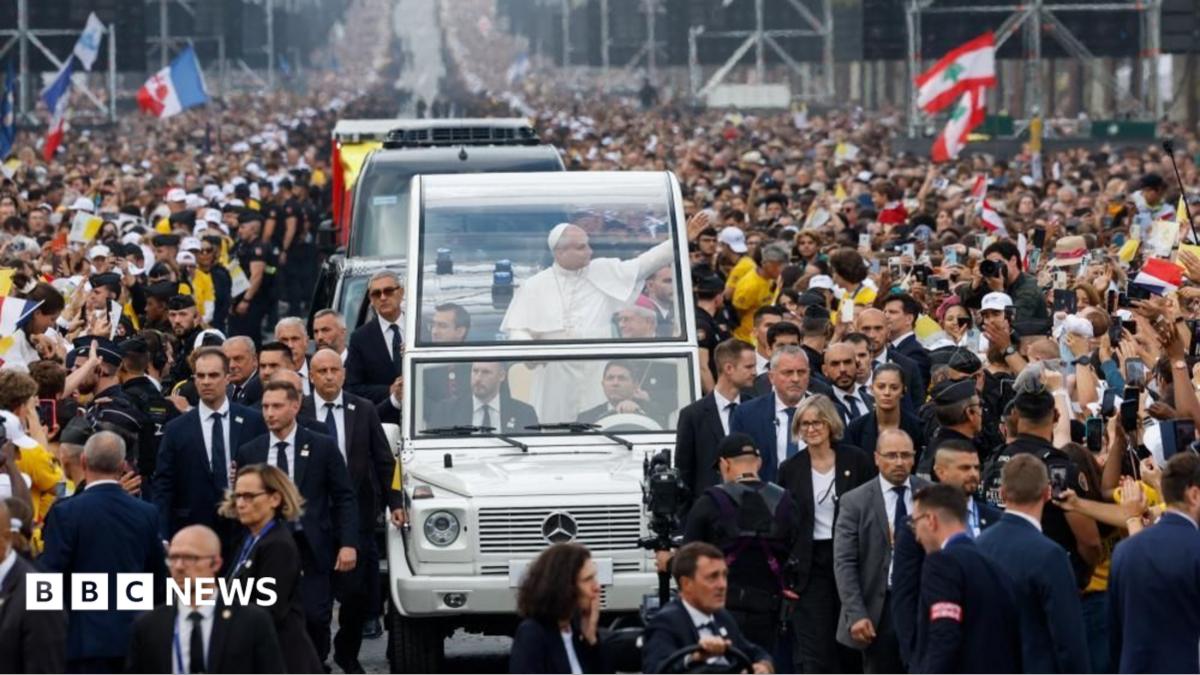
Hundreds of thousands of Roman Catholics and curious onlookers filled the heart of Paris on Saturday as Pope Leo XIV celebrated a giant open-air Mass beneath the Arc de Triomphe, in one of the largest religious gatherings the French capital has witnessed in recent memory.
The pontiff travelled down the Champs-Élysées in his popemobile, waving to the crowds that lined the famous avenue and stopping at several points to bless infants held up to him by their parents. Chants of "Leo, Leo" echoed along the tree-lined boulevard as the procession made its way toward the Place de la Concorde.
Organisers expect more than half a million people to attend the ceremony, for which a special altar has been constructed on the vast square at the eastern end of the Champs-Élysées. The scale of the event has required extensive security and crowd-management arrangements across central Paris, with large sections of the city centre closed to traffic for much of the day.
The visit carries considerable symbolic weight for the Catholic Church in France, a country with a deeply rooted Catholic heritage but also a long tradition of secularism. Church leaders believe the turnout reflects a renewed interest in spirituality among the French and other Europeans, a trend they hope the papal trip will reinforce.
President Emmanuel Macron held an hour of talks with the Pope on Friday but was not scheduled to attend any of the Masses during the four-day visit. The decision is widely understood as an effort to respect France's strict legal separation between church and state, a principle known as laïcité that has shaped French public life for more than a century.
Other senior political figures were present, however. Brigitte Macron, the president's wife, and Prime Minister Sébastien Lecornu attended the Champs-Élysées Mass, underscoring the event's national significance even as the head of state kept his distance.
The ceremony also drew a cross-section of figures from French politics, with several candidates for next year's presidential election expected among the congregation. Marine Le Pen of the hard-right National Rally and the conservative Bruno Retailleau were both photographed at the Place de la Concorde before the service began.
Centrist contenders Edouard Philippe, the mayor of Le Havre and a former prime minister, and Gabriel Attal were also due to attend. François Fillon, another former prime minister, was seen at the square as well, highlighting how the papal visit has become a fixture on the country's political calendar.
Earlier in the day, the Pope turned his attention to some of society's most vulnerable people. He visited the Maison Bakhita, an association that supports refugees, where he met migrants and praised the organisation for inviting people "to see those who are invisible."
Speaking during that visit, Leo said it was "possible to encounter one another and to live together in dignity and peace." He also emphasised what he described as the fundamental role of women in building what he called a civilisation of love.
The Pope's engagement with migration and social inclusion reflects a consistent theme of his young pontificate, and his choice to begin the day at a refugee centre sent a pointed message in a country where immigration policy has become a fiercely contested political issue.
On Friday, at the outset of his trip, Leo used a speech to Church and state officials at the Élysée Palace to warn about the dangers of artificial intelligence. He cautioned against "losing our humanity amid a paradise of machines," urging his audience to keep human dignity at the centre of technological change.
The address added the Pope's voice to a growing international debate over how rapidly advancing AI systems should be governed, and it signalled that he intends to make the ethical implications of new technology a signature concern of his papacy.
The visit continues on Sunday, when around 150,000 people have registered to attend a Mass at the sanctuary of Lourdes in the Pyrenees, one of the most important pilgrimage sites in the Catholic world. The sanctuary has drawn millions of pilgrims since reports of apparitions there in the nineteenth century.
On Monday the Pope will travel to Metz in northeastern France, where he will pay tribute to Robert Schuman, a fervent Catholic and a founding father of the European Union who served as a French foreign minister. Schuman, who lived from 1886 to 1963, is currently a candidate for beatification, the step before possible sainthood.
The itinerary's combination of a major urban Mass, a refugee centre, a Marian shrine and a tribute to a European statesman offers a portrait of a papacy that blends traditional devotion with contemporary social and political concerns.
Pope Leo XIV was born in Chicago in 1955 under the name Robert Prevost, a surname with French roots. His paternal grandmother was born in Le Havre in Normandy in 1894, and when she later married in the United States, she and her Italian husband adopted the name Prevost, which had been her mother's maiden name.
That family history gives the current trip an additional personal dimension, linking the American-born pontiff to the Norman port city and to the French ancestry that helped shape the name he carries today.
For the hundreds of thousands who gathered in Paris on Saturday, however, the day was defined less by politics or ancestry than by the spectacle of a pope moving through one of Europe's most iconic streets, greeted by a sea of waving flags, camera phones and cheering voices.
What's Your Reaction?
 Like
0
 Dislike
0
 Love
0
 Funny
0
 Wow
0
 Sad
0
 Angry
0

Reporter Senior. Meliput dinamika politik nasional, kebijakan publik, dan isu parlemen selama 8 tahun. Alumni FISIP UI.





Comments (0)