

Swiss Voters Back Sanctions on Russia, Reject Locking In Neutrality
Swiss voters have decisively rejected a proposal to harden the country's longstanding tradition of diplomatic neutrality into a stricter legal code, official results showed. More t
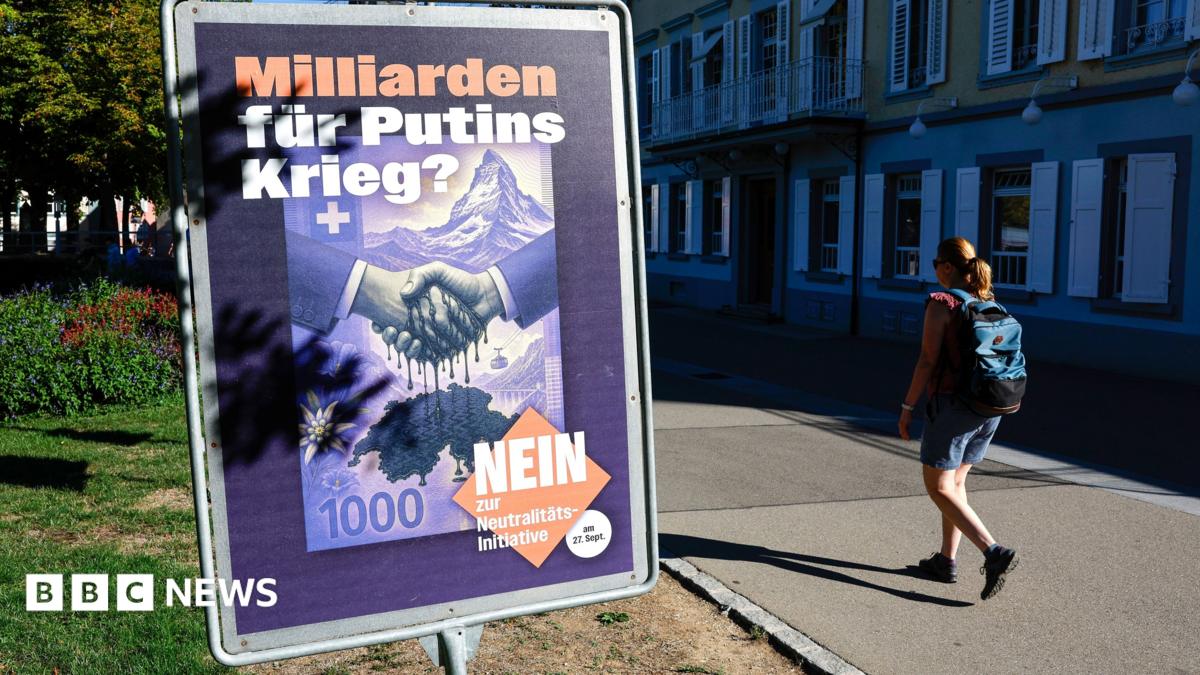
Swiss voters have decisively rejected a proposal to harden the country's longstanding tradition of diplomatic neutrality into a stricter legal code, official results showed. More than 70% of those who cast a ballot voted against what campaigners called the "Neutrality Initiative," handing a clear verdict to a question that had bitterly divided the Alpine nation for months.
The rejected package would have barred Switzerland from adopting EU-style sanctions unilaterally without the authorisation of the United Nations Security Council. It would also have closed the door on any move toward a closer partnership with the Nato military alliance, at a time when European governments are bolstering collective defence arrangements in response to Russia's full-scale invasion of Ukraine. Supporters argued that only such a blanket restriction could guarantee that Bern's reputation for independence survived the war in Ukraine; opponents countered that it would strip the country of every practical tool it has to respond to outright aggression.
Russia openly campaigned for the initiative, the article reports, a fact that appears to have done considerable damage to its chances among Swiss voters. The measure was championed domestically by the right-wing Swiss People's Party, which has made opposition to sanctions on Moscow a cornerstone of its platform. Every other major party, along with the federal government, opposed it — an unusual show of unity that framed the vote as a straightforward question of how far a neutral country should go in punishing an armed aggressor.
Lukas Golder, co-director of the research institute Gfs.bern, told Swiss public broadcaster SRF that the result should not be read as a repudiation of neutrality itself. In his assessment, Swiss voters were not rejecting the idea that their country should stay outside military alliances; rather, the outcome demonstrated public support for maintaining sanctions against Russia. "People have a clear idea of what Switzerland's neutrality is supposed to achieve," he said — an achievement defined less by passivity than by the state's usefulness as a mediator and trusted diplomatic channel.
Foreign Minister Ignazio Cassis made a similar argument during a televised debate ahead of the vote, arguing that Swiss neutrality has never been an inflexible prison but a tradition applied with a pragmatic degree of flexibility. He stressed that the government has no intention of lifting the ban on selling arms to countries engaged in conflict, Ukraine included. But he drew a firm line between restraint and detachment: "neutrality does not mean indifference," he said, adding that Switzerland will "not look away when we see violations of the very international rules that allow us to live in peace."
The vote landed on a foundation of legal history that stretches back more than two centuries. Switzerland was granted "eternal neutrality" at the Congress of Vienna in 1815, at a moment when the Napoleonic Wars had laid waste to Europe and the great powers were searching for a way to stabilise the continent. Neutrality was later given a firmer legal footing by the Hague Convention of 1907, which prohibited the supply of weapons to any country at war — a provision that still shapes Bern's arms-export policy today.
That convention has been tested repeatedly in recent years. Switzerland has previously turned down a request from Germany for ammunition destined for tanks being sent to Kyiv, an episode that drew criticism at home and abroad that the country was applying a 120-year-old rule selectively. Critics of the initiative argued that a written, watertight definition would only make such accusations louder, whereas opponents of the measure pointed out that an inflexible text would have forced Bern to stand aside even as European neighbours issued coordinated sanctions.
The debate also reopened deeply uncomfortable chapters of the Second World War. Switzerland stayed neutral throughout the conflict, but neutrality did not mean cleanliness: the country accepted Nazi-looted gold, and its authorities turned away thousands of Jewish refugees in an effort to avoid antagonising Nazi Germany. Official Swiss apologies for those policies did not come until the 1990s, decades after the events themselves.
Analysts say the campaign nonetheless exposed how different generations now read that history. For many voters, the memory of accommodation with an aggressive power outweighs any discomfort about targeted economic measures against Moscow, while others continue to worry that abandoning even the appearance of even-handedness could compromise the country's role as a host for international dialogue and as a venue for peace negotiations.
The mechanics of Swiss politics shaped the outcome as much as the arguments did. Because the country operates a system of direct democracy, major policy questions are routinely deferred to the electorate through referendums, and a single vote can redraw the boundaries of foreign policy overnight. It also means the government must now operate within what appears to be a clear popular mandate, even if the 70% figure conceals debate about precisely what was endorsed.
For Bern, the practical effect is significant. The government retains wide discretion to continue supporting and joining European sanctions packages, to allocate aid to Ukraine and to keep channels open with Moscow, without fear that a single well-organised campaign could tie its hands. The result strengthens the hand of those who argue that a neutral state's greatest contribution to international order is not silence but selective, legal and proportionate pressure on those who violate it.
What the vote did not settle is how far that flexibility stretches. Switzerland has signalled no intention of abandoning its arms embargo, and the government continues to describe itself as a reliable partner of Nato without seeking membership. The question is likely to return the next time Europe debates collective security measures, and with the authority of the ballot box now firmly behind the government's position, Switzerland enters that argument from a position of unusual strength.
For the wider diplomatic community, the outcome is a reassurance that the country most associated with neutrality is not retreating into isolation. Bern's argument — that strict neutrality in the age of missiles and drones can amount to complicity — has been accepted not by a parliament, but by the electorate. Whether that settles the debate for long, or merely postpones it, will depend on how the war in Ukraine ends.
What's Your Reaction?
 Like
0
 Dislike
0
 Love
0
 Funny
0
 Wow
0
 Sad
0
 Angry
0

Reporter Senior. Meliput dinamika politik nasional, kebijakan publik, dan isu parlemen selama 8 tahun. Alumni FISIP UI.






Comments (0)