

Bangkok Declares Flood Emergency as Canals Overflow and 50 Districts Become Emergency Zones
Bangkok's authorities have declared a flood emergency across the Thai capital after two days of relentless heavy rain left major roads submerged, overwhelmed the city's drainage ne
Bangkok's authorities have declared a flood emergency across the Thai capital after two days of relentless heavy rain left major roads submerged, overwhelmed the city's drainage network and pushed water out of canals into surrounding neighbourhoods. The announcement, reported by the BBC, marks one of the city's most serious weather emergencies in recent memory and affects all 50 of Bangkok's districts, each of which has now been designated an emergency zone.
The deluge followed roughly 48 hours of extreme rainfall, during which drainage systems were inundated and traffic ground to a halt on roads that are already notorious for congestion. Residents have been urged to stay at home where possible, and those living beside the city's dense network of canals have been advised to shift their belongings to upper floors in case the water continues to rise. Officials have also expressed concern that further canals could burst their banks as the downpour continues.
Seasonal storms are a familiar feature of life in Thailand at this time of year, and heavy rain is not unusual for the capital. What distinguishes this event is its intensity. Rather than a routine tropical shower, the weather system of recent days has delivered rain in volumes far beyond what the city's flood defences were designed to handle, and officials have acknowledged that pumping crews are struggling to keep pace with water accumulating faster than it can be drained away.
One resident, Somkid Pheuk-ngam, 67, who lives near a canal just north of central Bangkok, described water rising to roughly waist height outside her home. Speaking to the AFP news agency, she said the water kept arriving, that going out had become extremely difficult and that she had been forced to shut her shop for two days. She added that conditions in the city appeared to her to be worse than in 2011, when Thailand endured one of the most devastating flood events in its modern history.
That 2011 comparison carries significant weight. Three months of nationwide flooding that year killed hundreds of people, submerged homes, farms, factories and transport networks, and remains the benchmark against which Thai flood preparedness is routinely measured. However, the BBC reports that no casualties have been reported in Bangkok itself in connection with the current flooding, a point officials will draw comfort from even as conditions remain fluid.
City governor Chadchart Sittipunt said the eastern part of the city had been the worst affected area. He acknowledged that rain was continuing to fall and that response teams were working around the clock, saying authorities were doing their best to pump water out but that canal levels left little room for manoeuvre. His warning was directed at those in the highest-risk locations: residents living near canals, all of which he said were now full.
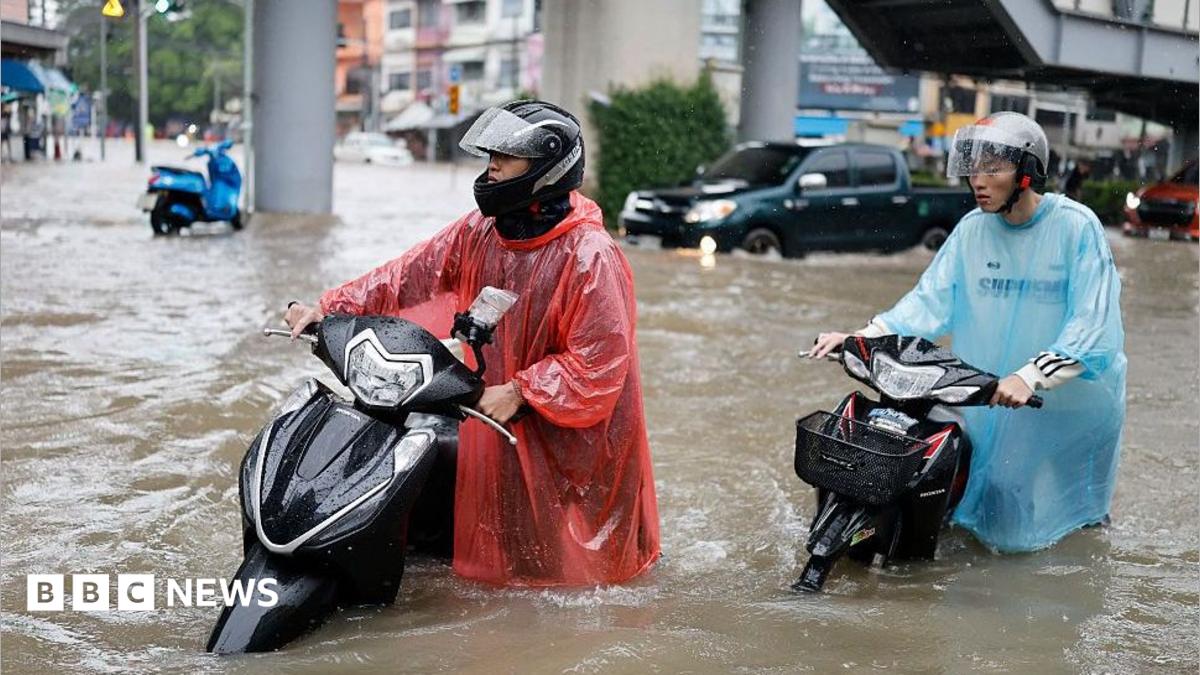
The immediate concern for officials is that the system has nowhere left to go. Saturated canals and overwhelmed drainage leave little margin for further rainfall, and authorities have said they are pumping water out as quickly as physically possible. Images from the capital show men pushing scooters through standing water, pedestrians navigating narrow flooded side streets under umbrellas, and aerial views of neighbourhoods largely covered by brown water.
Forecasting agencies have not offered much comfort. The Thai Meteorological Service has forecast further heavy rain through the week, which would keep water levels rising even as the immediate downpours ease. The service noted, however, that the area of low pressure responsible for the recent deluge is expected to move towards central Thailand, which could signal a gradual shift in conditions over coming days.
The timing of the rainfall is also significant. Flood disasters in Bangkok tend to peak during the monsoon transition, when storms build and drainage systems are already running close to capacity. With rain forecast to continue into Sunday and beyond, and with the entire city now operating under emergency designation, the immediate priority is the safety of residents in canal-side communities and the restoration of mobility across a transport network that carries millions of daily journeys.
Longer term, the flooding is likely to renew debate about Bangkok's exposure to extreme weather. The Thai capital has long been described as one of the world's most flood-prone major cities, sitting below sea level in many areas and reliant on a network of canals and pumps that dates back generations. Events of this scale tend to accelerate arguments over whether that infrastructure can be upgraded fast enough to keep pace with a changing climate and a rapidly growing urban population.
For now, though, attention remains fixed on the water level. With every canal reported full, further rain could mean further overflow, further evacuations of belongings to upper floors and further disruption on roads across the capital. The declaration of a flood emergency disaster formalises the city's response, but the governor's own assessment — that the rain is still falling and the risk is concentrated around the canal network — captures the uncertainty that residents like Somkid Pheuk-ngam, unable to leave her shop and her street, are living through day by day.
What's Your Reaction?
 Like
0
 Dislike
0
 Love
0
 Funny
0
 Wow
0
 Sad
0
 Angry
0

Fact Checker Politik. Memverifikasi klaim publik, pidato pejabat, dan informasi viral. Anggota jaringan cek fakta Indonesia.




Comments (0)