

France Detains Over 400 as High School Protests Intensify Nationwide
French authorities detained more than 400 people on Tuesday, the majority of them minors, as student demonstrations at high schools escalated across the country, Interior Minister
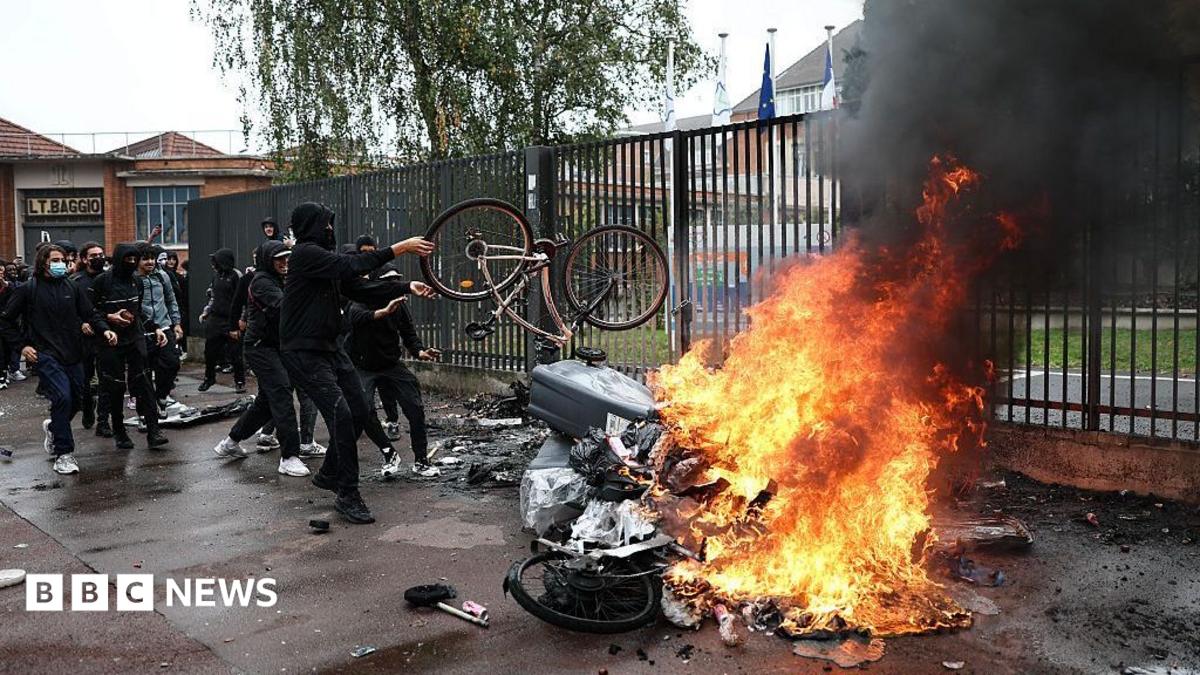
French authorities detained more than 400 people on Tuesday, the majority of them minors, as student demonstrations at high schools escalated across the country, Interior Minister Laurent Nuñez confirmed. Speaking to broadcaster BFMTV, Nuñez said the figure was not yet final but that roughly two-thirds of those detained had been placed in police custody. The detentions marked a sharp rise from the previous day, when 164 people were arrested, underscoring the rapid expansion of a movement that began just over a week ago in the Paris region.
The protests, which started in the Île-de-France area surrounding the capital, have seen teenagers blockading their schools for several consecutive days. According to the education ministry, at least 400 schools were affected by Tuesday's disruptions. Images and videos circulating on social media appeared to show burning bins and damaged bus stops, while French media reported that demonstrators threw projectiles at police officers, who responded with batons and tear gas.
The unrest has come at a significant cost. Officials reported that at least ten teachers, several students, and 48 law enforcement personnel were injured during Tuesday's protests. The scale of the casualties highlights the intensity of the confrontations, which have spread well beyond the capital. One particularly vivid scene unfolded in Lille, where students carried out a blocking protest at the César Baggio secondary school, with black smoke billowing from burning bins and bicycles.
At the heart of the movement are long-standing grievances over conditions in France's education system. Students point to overcrowded classrooms and persistent teacher shortages as the primary drivers of their anger. One 16-year-old female student, speaking to the AFP news agency, explained the demonstrators' motivations. "We're here to deliver a message," she said. "We're not here to smash everything up for no reason. We're here precisely to say that the education system is completely broken. There are 34 of us in each class, and it's just not feasible. The teachers are overworked."
The student actions coincided with a broader day of industrial action across France. Unions representing teachers, hospital staff, and civil servants staged nationwide walkouts to protest low wages and deteriorating working conditions. Nuñez said these wider demonstrations, which drew at least 200,000 participants, mostly passed without incident, suggesting the violence was concentrated among the school-age protesters.
Political reactions have been swift and sharply divided. Education Minister Édouard Geffray acknowledged on X, the platform formerly known as Twitter, that students have the right to protest but condemned the reported violence as "indefensible." In a subsequent post on Tuesday evening, he struck a firmer tone. "The right to demonstrate is a fundamental freedom that cannot serve as an excuse for such actions," Geffray wrote. "To legitimise them or, in this context, to call for extending the blockades is to endanger our students as well as public employees. It is irresponsible."
Interior Minister Nuñez faced scrutiny over the police response, which has drawn criticism from several French politicians. When pressed on the matter, Nuñez insisted that law enforcement had acted "in an extremely proportionate manner." His defence came as Ryad Rani, president of the Union Syndicale Lycéenne, a body representing students, accused the French government of "repression" and the police of using excessive force. The competing narratives reflect a familiar tension in French public life, where the right to protest is fiercely protected but frequently collides with concerns over public order.
The escalation follows a warning from Prime Minister Sébastien Lecornu on Monday, after the first wave of 164 arrests. Lecornu described any further escalation as "irresponsible," citing reported incidents including fireworks, fires, and violence near high schools. "Nothing justifies endangering students, staff, or police officers," he wrote on X. His intervention signalled that the government views the unrest as a serious challenge, though it has so far stopped short of announcing concrete measures to address the students' underlying complaints.
The movement at French lycées, which are equivalent to sixth-form colleges in the UK or high schools in the US, has tapped into deeper anxieties about the state of public education. France's teaching profession has long complained of eroding purchasing power, understaffing, and growing class sizes, issues that successive governments have pledged to tackle with mixed results. The decision by students to blockade their own schools represents an escalation in tactics, moving beyond traditional marches and rallies to disrupt the daily operation of the education system itself.
The timing of the protests is also significant. The nationwide union walkouts brought together a broad coalition of public-sector workers, from hospital staff to civil servants, under a shared banner of frustration over pay and conditions. While the student demonstrations are distinct in their demands, they have effectively merged with this wider wave of social discontent, amplifying pressure on the government. The reported participation of at least 200,000 people in the union-led actions suggests that public dissatisfaction extends well beyond the school gates.
For the government, the challenge is twofold. It must restore calm in and around schools while avoiding the appearance of heavy-handedness that could further inflame opinion. The criticism from the Union Syndicale Lycéenne and sympathetic politicians indicates that the police response is already a politically charged issue. Every baton charge or tear-gas deployment risks becoming a symbol that galvanises more students to join the blockades, particularly in a country with a strong tradition of youth-led protest.
As of Tuesday evening, the situation remained fluid. The government had not signalled any retreat on discipline, and student representatives showed no inclination to stand down. With teachers and students both nursing grievances and the broader public sector equally restive, France appears to be entering a period of sustained social tension. Whether the detentions and warnings will deter further blockades or instead deepen the standoff is likely to become clear in the coming days, as unions and student groups weigh their next moves.
What's Your Reaction?
 Like
0
 Dislike
0
 Love
0
 Funny
0
 Wow
0
 Sad
0
 Angry
0

Reporter Senior. Meliput dinamika politik nasional, kebijakan publik, dan isu parlemen selama 8 tahun. Alumni FISIP UI.





Comments (0)