

Ramaphosa Orders Nationwide Safety Audits After Discovery of 12 Women Killed Near Johannesburg
South African President Cyril Ramaphosa used a national address on Tuesday to announce a sweeping clean-up of high-risk areas across the country, following the discovery of the bod
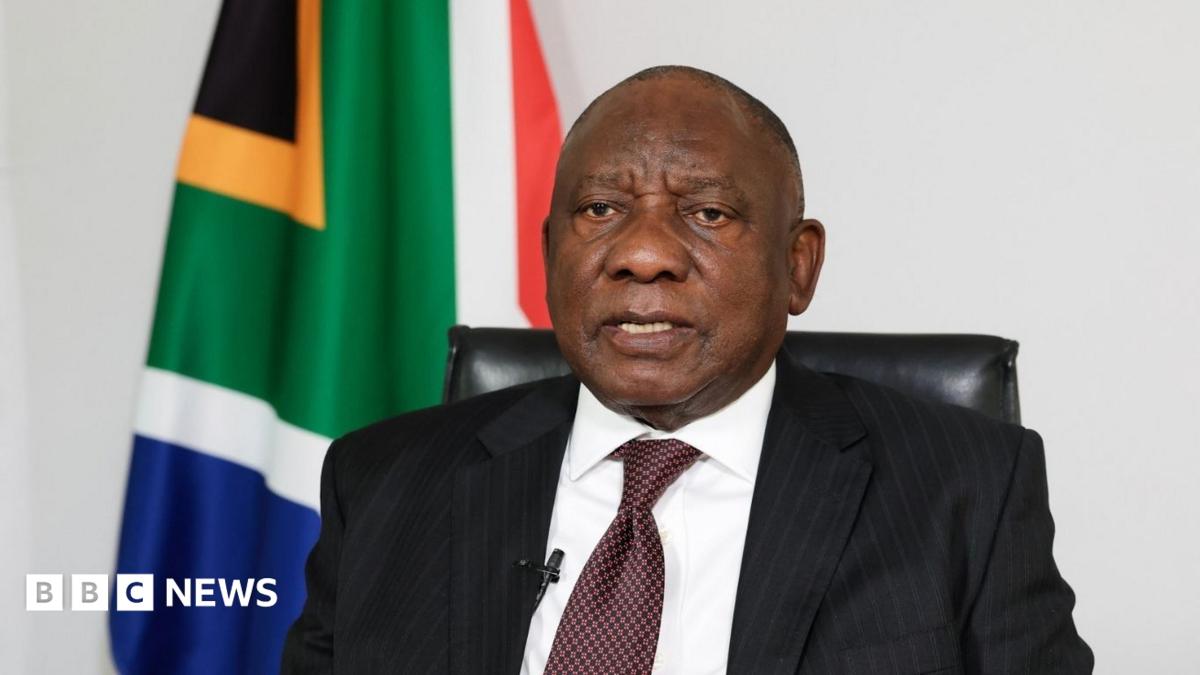
South African President Cyril Ramaphosa used a national address on Tuesday to announce a sweeping clean-up of high-risk areas across the country, following the discovery of the bodies of 12 women in a single district east of Johannesburg over a two-month period. Speaking to the nation, he described the response as a multidisciplinary, national-level emergency response to the murders, part of which has already produced four arrests.
The killings have triggered an outcry across South Africa, a country that the United Nations and domestic rights groups repeatedly describe as having one of the highest rates of gender-based violence in the world. Police are continuing to investigate, and the president said officers had not yet established whether the cases are linked.
Addressing widespread public anxiety, Ramaphosa acknowledged that many South Africans have understandably feared that the proximity of the bodies could point to a single serial offender operating in the area. He cautioned against that assumption, saying that at present investigators have found no evidence establishing that the killings were committed by one perpetrator. That distinction matters both for the investigation and for public safety: an unconfirmed theory of a single predator has driven a great deal of the fear and outrage surrounding the case, and police have been keen not to let speculation narrow the search before the evidence supports it.
Central to the announcements was an instruction that every municipality in the country begin a women's safety audit without delay. Ramaphosa said the audits must first identify high-risk areas and then address them, examining the physical conditions that shape women's vulnerability in public space. Among the specific hazards he listed were broken streetlights, overgrown and neglected public spaces, abandoned buildings, unsafe transport routes and facilities, and poorly secured parks.
The framing is significant because it shifts the response from a purely criminal-justice model toward what officials describe as prevention. Lighting, abandoned structures, transport and the design of shared spaces have long been debated in South African municipal politics as everyday determinants of women's safety, particularly at night and in townships and informal settlements where public transport corridors and unoccupied plots are plentiful. Handing every local authority an audit mandate effectively distributes responsibility for identifying those risks to the level of government closest to them, while also making failures easier to document and, potentially, to challenge publicly.
Ramaphosa also announced what he termed an enforcement package aimed at reducing alcohol-related violence. He was careful to separate cause from aggravation, arguing that alcohol does not cause gender-based violence and can never serve as an excuse for it, and that responsibility for such crimes always lies with the perpetrator. At the same time, he said harmful alcohol use is a significant aggravating factor in interpersonal violence and must be tackled as part of a broader prevention strategy.
In his address, the president conceded that the state has not done enough in recent years to shield women and girls, and said such violence cannot be treated as an acceptable, normal feature of life in South Africa. The admission carries weight because it comes from the head of state at a moment of acute public pressure, and it sets a benchmark against which the effectiveness of the new measures will later be judged.
Beyond policing and legislation, Ramaphosa argued that lasting change will require a shift in attitudes. Violence, he said, does not begin at the moment a fist is raised or a woman is raped or murdered, but far earlier, in attitudes that treat women as inferior and that assume a man's entitlement to control a woman. He pointed to what he described as the substitution of jealousy for love, control for protection, and coercion for affection, and to the refusal to accept the word no as the first stages of that process.
He then turned to men and boys, calling on them to take the lead in ending gender-based violence. The burden of male violence, he said, has been placed on women, and that arrangement has to change. He rejected the idea that the remedy is to make women less free, a formulation that echoed demands from civil society campaigners that policy responses should never be framed as restrictions on women's movement, work or rights.
The scale of the underlying problem is illustrated by official figures included in the reports on the case. South Africa has one of the world's highest homicide rates, with 5,427 people murdered between April and June alone. Police statistics do not, however, break victims down by gender. Filling that gap, the South African Human Rights Commission said recently that 569 women were killed and a further 1,052 survived attempted murder over the same three-month period — figures that underline why individual cases, however horrifying, sit within a much larger and persistent pattern.
Analysts caution that the announcement's real test will be implementation rather than language. Audits require trained personnel, data and money in municipalities that are often under strain, and an audit without a budget to fix broken lighting or secure transport is a document rather than a remedy. Observers will therefore be watching for deadlines, named officials, and published findings, as well as the pace of the four arrests and any further detentions in the Johannesburg-area investigation.
For families of the 12 women, and for a country reckoning with a crisis that has produced repeated waves of grim discoveries in recent months, the immediate hopes are more modest: identification of the victims, accountability for those responsible, and a set of interventions that outlive the news cycle that produced them. Ramaphosa's own framing suggests he sees the task in those terms, locating the origins of the problem in attitudes formed long before any crime is committed. The measure of the response, and of the address, will be whether those words harden into routine municipal work and a measurable shift in how perpetrators are held to account — a test the president himself has now set in public.
What's Your Reaction?
 Like
0
 Dislike
0
 Love
0
 Funny
0
 Wow
0
 Sad
0
 Angry
0

Reporter Senior. Meliput dinamika politik nasional, kebijakan publik, dan isu parlemen selama 8 tahun. Alumni FISIP UI.






Comments (0)