

Himalayan Monal Alters Its Voice as Human Activity Squeezes Its Mountain Habitat, Indian Studies Find
Two separate studies conducted by researchers in India have found that the Himalayan monal, a striking pheasant native to the mountain forests of the Himalayas, is being forced to
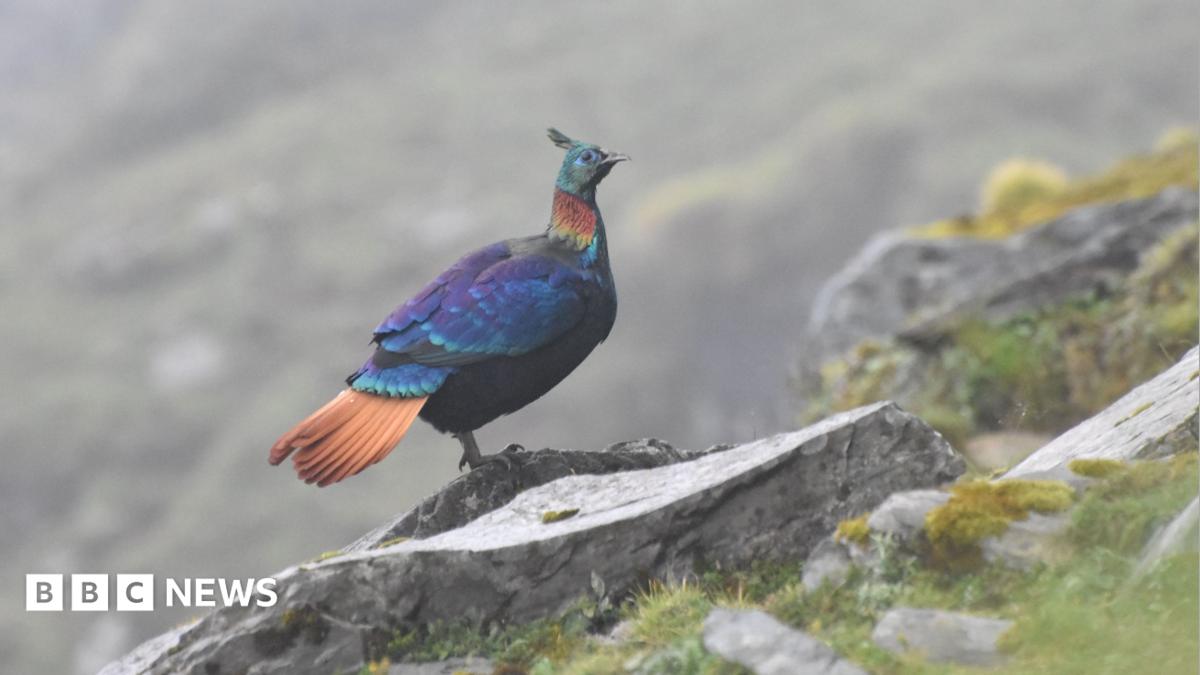
Two separate studies conducted by researchers in India have found that the Himalayan monal, a striking pheasant native to the mountain forests of the Himalayas, is being forced to change both where it lives and how it communicates as human activity intensifies across its range. The findings, based on five years of fieldwork and modelling in the Indian Himalayan state of Uttarakhand, point to infrastructure development, tourism and a changing climate as key drivers of the bird's shifting behaviour.
The monal occupies a special place in Himalayan culture. It appears throughout regional folklore and is closely tied to the identity of mountain communities. The male of the species is especially recognisable, sporting iridescent green, blue and copper plumage, while the female is a more subdued brown and white. The bird serves as the state bird of Uttarakhand and the national bird of Nepal, underlining its symbolic importance across the mountain region.
According to the research, the bird is being squeezed from two directions at once. One study found that monals are moving to higher elevations as their natural habitat in alpine meadows above the tree line becomes increasingly crowded by human use. The second study concluded that the species is altering the pitch of its calls in order to be heard over human noise in a busy valley.
Vishal Singh, an environmental practitioner who works on ecology and climate issues in the Himalayas, described the twin findings as a warning sign. He noted that if a bird as adaptable as the monal is being forced to change both its voice and its location, the implications for more sensitive species could be far more serious. The monal, in other words, may be acting as an early indicator of wider ecological stress.
Dr Rajeev Lochan, who led both studies, explained to the BBC why the monal was chosen as the focus of the research. He said the bird has a narrow habitat range and moves seasonally between the lower montane zone on the mountains' lower slopes and the high-elevation alpine zone. That pattern of movement, he argued, makes the species a valuable indicator of overall ecosystem health in the north-western Himalayas. If the monal is struggling in this landscape, he added, it raises the likelihood that ecological disturbances are affecting other birds as well.
Researchers describe the monal as a stand-in for the health of a fragile Himalayan ecosystem that is being pushed towards a tipping point by unregulated tourism and heavy urbanisation. The region has long attracted tourists, trekkers and scientists because of its dramatic scenery and rich biodiversity, but rapid infrastructure expansion over the past decade has opened up more areas to visitors, driving up footfall and disrupting wildlife. Combined with growing human pressures, climate change is now emerging as an additional major threat to biodiversity in the region.
Singh framed the problem in broad terms, saying that at a general level the economic development of the region is not aligned with its ecological integrity. The tension between growth and conservation, he suggested, lies at the heart of the pressures now bearing down on species such as the monal.
The first study examined how climate change could affect the bird's habitat across the Indian Himalayas through the year 2100. Researchers modelled shifts in the monal's suitable habitat in Uttarakhand and Himachal Pradesh under a range of climate scenarios, using the kind of global climate models and emissions pathways employed by the Intergovernmental Panel on Climate Change, the United Nations' climate science body. The projections suggest that climate change will continue to shrink and destabilise the monal's habitat across the Indian Himalayas under multiple scenarios.
Alpine meadows sit high in the mountains above the forests and rank among the Himalayas' most important seasonal grazing areas and biodiversity-rich habitats. The researchers modelled how those areas could change, assuming that the bird will continue to require the climate conditions currently found in alpine meadows. That assumption, the study acknowledges, is reasonable but not certain.
Lochan said the birds are already gradually moving upwards as snow melts and vegetation spreads, making higher ground more accessible to them. At the same time, their natural habitat in alpine meadows is being encroached upon by humans, pushing them upwards regardless. The combination of a warming climate and expanding human use leaves the species with increasingly little room to manoeuvre.
The consequences for the monal's seasonal migration could be significant. As the climate shifts, the birds may be forced to move even higher, into smaller and more fragmented patches of suitable terrain. Their populations could become scattered across disconnected pockets, reducing opportunities for breeding between groups. That fragmentation raises the risk of long-term decline or local extinction, a threat the study says already exists.
The second study, conducted by Lochan alongside Dinesh Kumar Sharma and Anand Kumar of Hemvati Nand Bahuguna Garhwal University, focused on the bird's behavioural changes. The researchers carried out their work in two valleys within the Kedarnath Musk Deer Sanctuary in Uttarakhand, including Chopta, a tourist destination known for heavy traffic. There, they examined how the monal adjusts its calls in response to the noise generated by human activity.
Taken together, the two studies paint a picture of a species adapting in real time to pressures on multiple fronts. The monal is changing its pitch to cut through the noise of busy valleys while also shifting its range uphill as its alpine meadow habitat is degraded and the climate warms. Each adjustment carries costs, whether in the energy required to make itself heard or in the loss of connected breeding grounds.
For conservationists, the monal's plight carries a broader message. Because the bird is relatively visible and culturally valued, its responses to disturbance are easier to document than those of rarer or more secretive species. The changes observed in Uttarakhand's mountains may therefore offer an early glimpse of stresses that could soon affect a much wider range of Himalayan wildlife.
The research also highlights the difficulty of separating the effects of climate change from those of direct human encroachment. Tourism, road building and urban expansion alter habitats directly, while rising temperatures reshape them over longer timescales. In the case of the monal, both forces appear to be pushing the bird in the same direction: upwards, into shrinking and increasingly isolated pockets of mountain terrain.
What's Your Reaction?
 Like
0
 Dislike
0
 Love
0
 Funny
0
 Wow
0
 Sad
0
 Angry
0

Reporter Senior. Meliput dinamika politik nasional, kebijakan publik, dan isu parlemen selama 8 tahun. Alumni FISIP UI.





Comments (0)