

On the Edge of Taiz: Life and War at Yemen's Newest Front Line
The warning came moments after the vehicle stopped. "This is the first drone," a soldier travelling with our group said, gesturing upward. "It is usually followed by an attack." Th
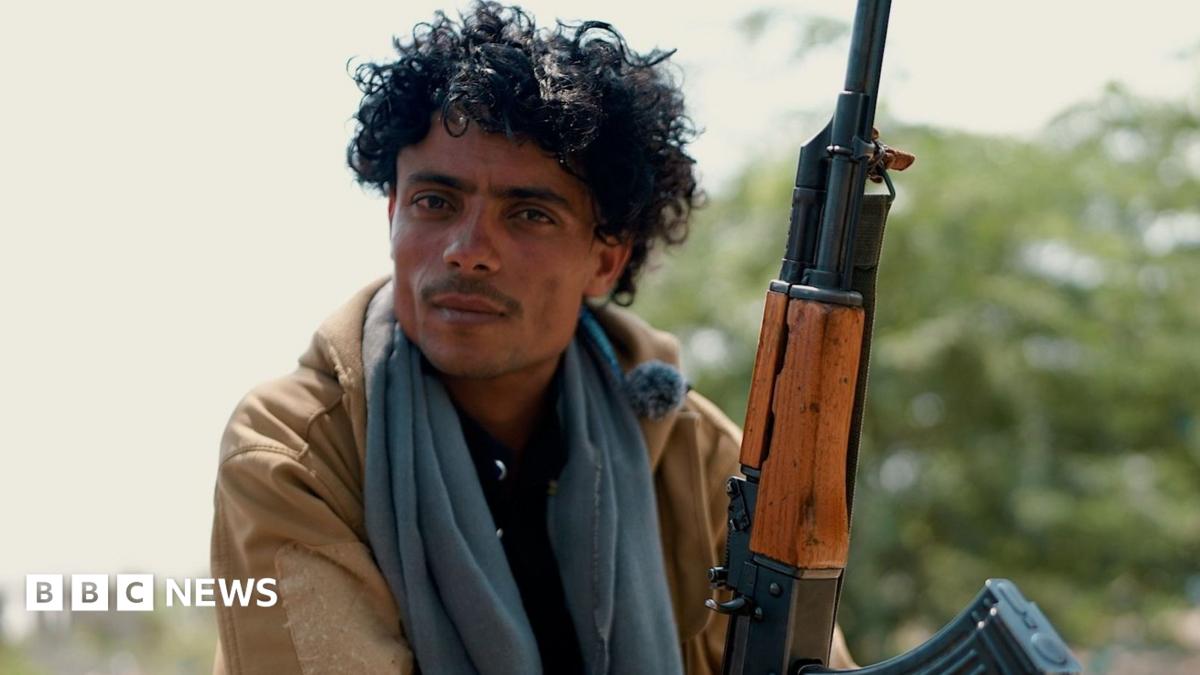
The warning came moments after the vehicle stopped. "This is the first drone," a soldier travelling with our group said, gesturing upward. "It is usually followed by an attack." The buzz overhead swelled as the team crawled beneath low bushes on the mountainside south-west of the city of Taiz, waiting in silence before climbing back in and driving away. Within roughly ten minutes, heavy thumps of incoming strikes echoed across the valley, one after another, their impact points impossible to determine from where we had taken cover.
What makes this stretch of terrain so hard to read is that the boundary itself is blurred. There is no trench line, no fence and no visible marker to announce where the Saudi-backed pro-government forces stop holding ground and no man's land begins. The front is instead defined by empty houses, unattended farmland and the direction of artillery fire. Government troops are fighting to halt Houthi fighters who swept south along the Red Sea coast earlier this month, seizing control of a key shipping chokepoint and re-igniting a civil war that had been frozen for most of four years.
Mapping data published by the Institute for the Study of War and AEI's Critical Threats Project illustrates the scale of what has shifted. Houthi-controlled territory stretches across much of western Yemen, including the capital, Sanaa, and runs south to the Red Sea and the Bab al-Mandab Strait, with contested ground clustered along the edges of that area. The most recent gains, mapped in September, follow the axis of the south-western coastal offensive — the same axis on which the city of Taiz now sits.
The human footprint of that advance is visible from the road. Homes are scattered across the slopes in ones and twos, but many stand abandoned, doors hanging open, after residents fled to escape the fighting. In the absence of the constant stream of cars and motorbikes that normally hums through Taiz, the quiet is unsettling. What remains is the bleating of livestock left behind and the crack of outgoing and incoming fire echoing off the rock.
Roughly a kilometre from the closest front-line positions, a man named Ali sat outside his home with a herd of goats. He has stayed put through it all, despite two mortar rounds having landed on his property. He sent his children to a displacement camp, he explained, because they could no longer endure the shelling and gunfire; he remained with his wife and sisters to care for the animals. He is frightened, he said, but sees no alternative: without the goats, the family would starve, and dying of hunger would be no better than dying under fire. He asked that only his first name be used, worried about reprisals if the Houthis take the area in the coming days.
That anxiety reflects a wider pattern on both sides of the line. Contacts on the Houthi side told reporters they are consolidating troops and preparing a major offensive. Government commanders, for their part, said they are aware of the build-up and are making their own preparations. The result is a standoff in which neither side appears to be consolidating its position at the expense of the other.
At the checkpoint nearest the front, we met fighters returning from positions held high on the mountain, only a few hundred metres from advancing Houthi fighters. One of them described a section of slope where the bodies of 18 government soldiers lay in territory his unit could fire across but could not reach. The fighting, he said, is at a distance measured in mortars rather than metres: they shoot over the position and can do nothing to recover the dead.
The intensity of the battle around Taiz has climbed sharply since the Houthis captured the strategic Red Sea port of Mokha, 85km to the west of the city, on 10 September — the move that unravelled a ceasefire which had largely held for four years. Along with the port itself, the group seized a swathe of high ground overlooking the Bab al-Mandab Strait, one of the world's busiest shipping corridors and the artery linking Europe and Asia.
The commercial consequences followed quickly. Rattled by the possibility of further disruption to supplies from the region, buyers pushed oil prices higher, and the strategic value of what the Houthis now hold became hard to overstate. Control of the strait is not merely a territorial gain inside Yemen; it is leverage over global trade routes, and therefore a bargaining asset in any attempt to end the war.
Taiz itself is Yemen's third largest city and its cultural capital, home to close to a million people. Geographically, it is the hinge between the Houthi-held north and the government-held south, and it is flanked by front lines running in several directions. Government forces control the centre of the city, while Houthi positions sit to its north and east, compressing the space in which civilians, aid workers and defenders can operate.
The fiercest recent fighting has taken place on the western approaches, where both sides contest elevated ground overlooking the route running south out of the city. The stakes of that battle are concrete: should the Houthis consolidate the high ground west of Taiz, government forces would face a considerably harder task in attempting to retake Mokha and the coast behind it. The mountain ridges above the city are, in effect, the hinge on which the next phase of the war turns.
Getting there is itself an illustration of how fragmented the war has become. Our route to Taiz began at Aden, where Yemen's internationally recognised Presidential Leadership Council and government are based. Along the way, we counted about 30 checkpoints, each one marking the point where responsibility for the road passed to a different commander — a visible sign of the fractured, competing nature of the forces fighting on the government side.
Approaching the city, ambulances began to overtake the convoy. We counted at least five within half an hour, all heading towards Taiz's main hospital, evidence of a steady flow of casualties that official reporting rarely captures. The contrast with the fronts is immediate: this is not a place emptied of life, but a city absorbing violence almost invisibly.
We arrived after dark. The shops were lit, the restaurants were full, and children played in the streets as if the war were something happening elsewhere. But the spell would break periodically, when the thud of shelling and the crack of gunfire from the surrounding mountains cut through the noise of the city. Between those moments, Taiz goes on trading, eating and waiting — a place where a front line runs through the middle of ordinary life without ever quite announcing itself.
What's Your Reaction?
 Like
0
 Dislike
0
 Love
0
 Funny
0
 Wow
0
 Sad
0
 Angry
0

Reporter Senior. Meliput dinamika politik nasional, kebijakan publik, dan isu parlemen selama 8 tahun. Alumni FISIP UI.





Comments (0)